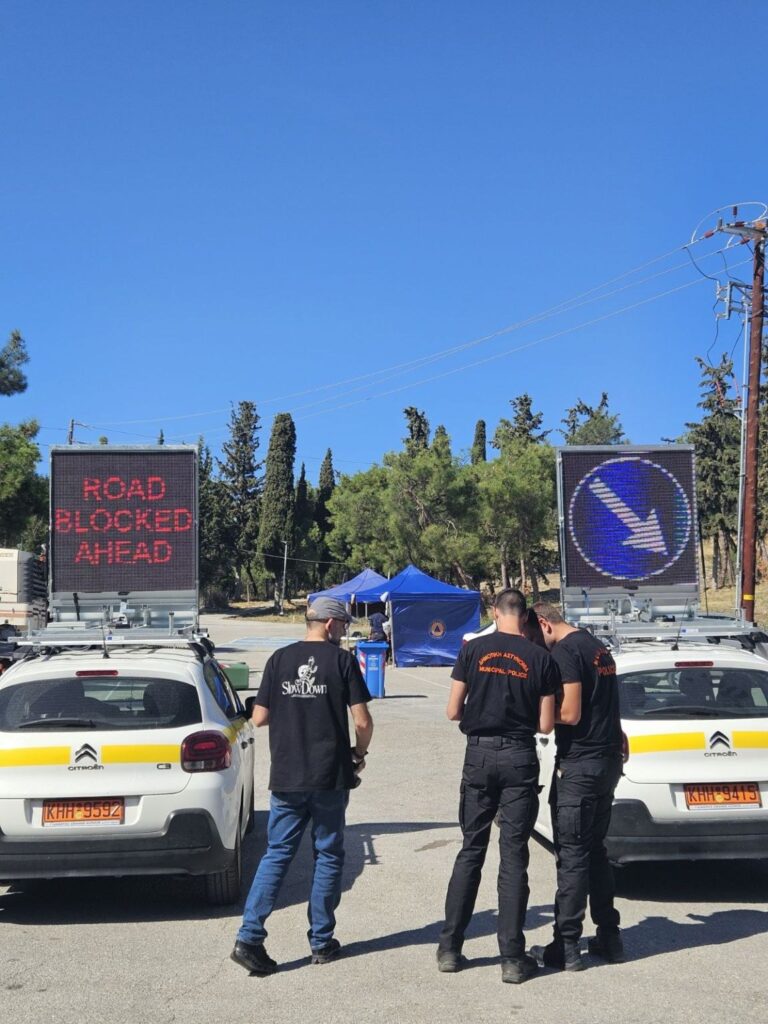
From 6 to 8 October 2026, the Municipality of Thessaloniki hosted a three-day iDriving pilot in the car park of the Forest Theatre (Theatro Dasous). Thessaloniki is one of iDriving’s pilot sites across six countries: Austria, Croatia, France, Greece, Romania and Spain.
What was tested
The pilot is part of iDriving’s Use Case 2, Infrastructure maintenance and road hazard monitoring. It tested tools that detect hazards caused by weather, such as heavy rain, flooding or strong winds, and send safety warnings in real time. The activities focused on:
- monitoring weather and environmental conditions;
- identifying potential hazards on the road network early;
- detecting and reporting incidents faster;
- using real-time data to improve road safety and the resilience of urban transport.
Drones as eyes in the sky
Drones played a central part in the pilot. Flying over selected high-risk spots, they used their on-board cameras to look for obstacles on the road, such as fallen trees, rocks or bins, and helped to monitor weather conditions. In line with the Municipality’s notice, the cameras were used only to detect environmental and road safety hazards, not to identify people or vehicles.
The video above shows how this looked on site: a drone flying over the test area, where a bin lying on its side served as a road obstacle, and test vehicles with roof-mounted equipment moving through the car park.
Drones across the iDriving project
Drones are one of several sources of data in iDriving, alongside static cameras, sensors and vehicles. During the iDriving trials in Graz, Austria, in February 2026, drones operated by Acceligence captured traffic footage that, combined with simulation models, produced warnings on variable message signs, and helped to detect vehicles in congestion scenarios. Read about the Graz trials. The project has also started to use drone data, together with AI-based 3D reconstruction, to build detailed 3D models of roads and accident scenes.
Why it matters
On city streets, a fallen tree or a flooded road can become dangerous within minutes. Spotting such hazards early and warning road users and road operators quickly is at the heart of iDriving’s aim to make urban and secondary roads safer.
Working with the city
The Municipality, and in particular its Municipal Police Directorate, worked with the project partners to test and evaluate the iDriving solutions in real urban conditions. Beforehand, the Municipality published a notice explaining that the tests were not designed to collect identifiable personal data. Read the notice (in Greek).
We look forward to sharing the results here once they are available.